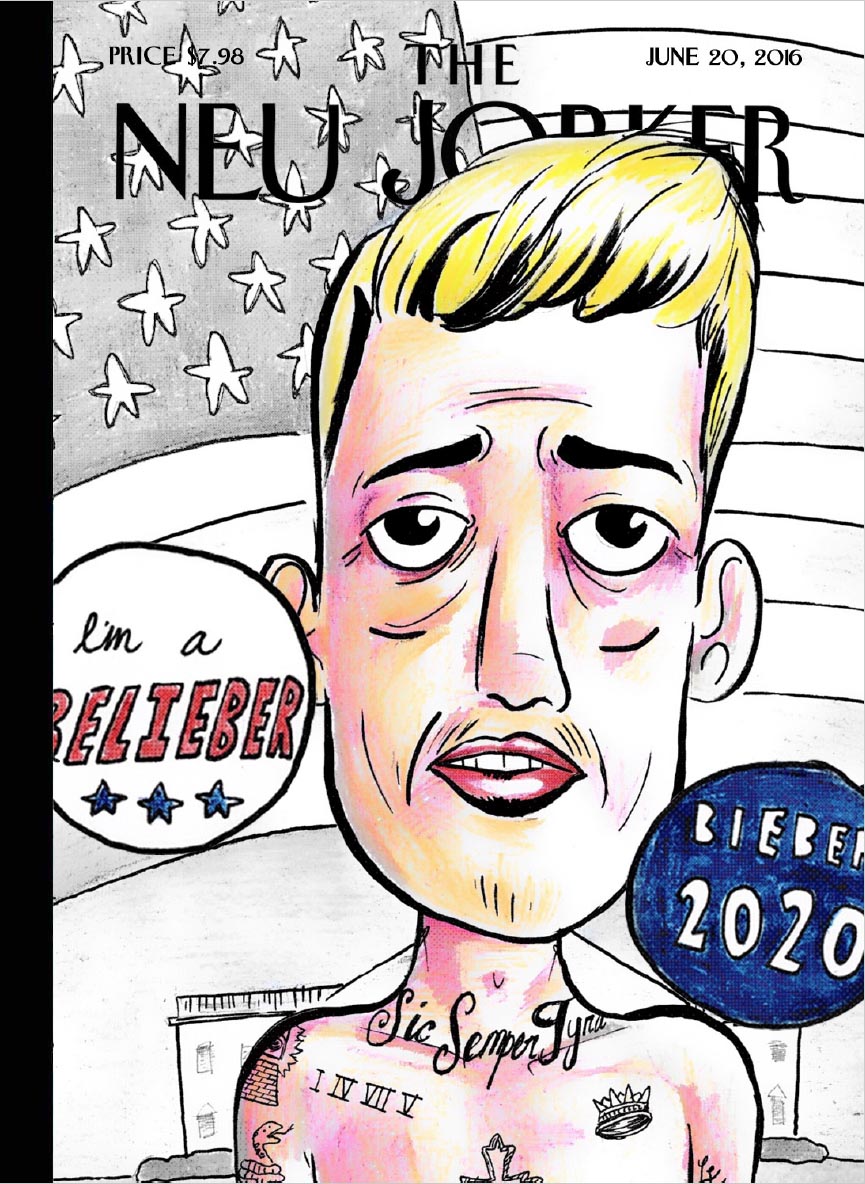
A great, new, free New Yorker parody!

Parody Of: The New YorkerTitle: “The Neu Jorker.”
Parody By: Andrew Lipstein, James Folta, et al.  Date: June 20, 2016. Pages: 80.
Contributors: Andrew Lipstein, James Folta, et al.
Availability: Online at 0s&1s Reads.

2016-Neu JorkerNo sooner do I launch this blog than a group of mostly web-based humorists go and release a full-length parody of The New Yorker called “The Neu Jorker.” You can read it here absolutely free. I just downloaded a copy, and the first few pages have me thinking it’ll be very good indeed. So does Alex McKown’s rave review at the AV Club. Snap it up before they figure out how to charge money for it. — VCR

Punch’s first “Pl*yb*y,” 1966

Hugh Hefner on Punch's 1966 Playboy cover

Punch’s view of Playboy in 2078, by Norman Mansbridge.

Parody Of: PlayboyTitle: “Pl*yb*y.”
Parody By: Punch.  Date: July 13, 1966. Pages: 4.
Contributors: Alexander Frater, Norman Mansbridge, William Hewison.
Availability: Occasionally sighted on eBay.

July 13, 1966

Punch at 125.

Two months before the Harvard Lampoon used the same asterisk-specked title, the 125th birthday number of Punch contained a brief parody of Playboy called “Pl*yb*y.” British magazines Queen and Country Life were targeted in the same issue, and in each case Punch tried to imagine what “its contemporary” would look like when it too had survived for a century and a quarter. Although Playboy wouldn’t reach that milestone until 2078, “Pl*yb*y” showed both magazine and editor-publisher Hugh Hefner looking much as they did in 1966 — with a few twists. In Punch’s 2078, Hef stays young with rabbit glands, the King of England is a novelist with a whipping fetish, and the 11,651st chapter of the “Playboy Philosophy” is a roundtable discussion of society’s outdated taboo against premarital nail-biting (which future-Hef boasts has always had a “positive, attractive, romantic image” in his magazine).

“Pl*yb*y” makes no attempt to duplicate Playboy’s uncluttered layout, allowing it to cram a full-size cover, the “Philosophy,” the King’s short story, some “Advisor” queries, a cartoon and a house ad into four pages. Writer Alexander Frater gets off a few mild jokes but doesn’t build on them, and he seldom captures Playboy‘s distinctive blend of over-alliteration, ankle-deep sophistication and lust for shiny objects. The fact that “Pl*yb*y” supposedly dates from the far-distant future is sometimes noted and sometimes ignored; in any case, it’s irrelevant to the intended critique of Playboy‘s squeaky-clean, All-American hedonism. (The Queen and Country Life parodies, set it 1986 and 2022 respectively, are sharper and funnier.)

Page 2 of Punch's 1966 Playboy parody

The “Hewsokolini” signature is cartoonist William Hewison’s nod to Erich Sokol and Eldon Dedini.

The most effective bits in “Pl*yb*y” are Norman Mansbridge’s cover caricature of Hefner and William Hewison’s mashup of fellow cartoonists Dedini and Sokol. Hewison, who was then Punch‘s art editor, also included an anniversary-related inside joke for cartoon buffs: As his two lovelies survey the pinup-strewn bachelor pad of their would-be bedmates, one says, “We won’t get much action here — these boys prefer the shadow to the substance.” “Substance and Shadow” was the caption of a famous cartoon by John Leech that Punch had run in July 1843 under the heading, “Cartoon, No. 1” — the first use of that word to describe a piece of satirical art.

Punch took on Playboy again in 1971 with a full-length parody that sold out in the U.K. and was reprinted in the U.S. the following year. I hope to get around to it sometime soon — or at least before 2078. — VCR

Harvard Lampoon Parodies Since 1911

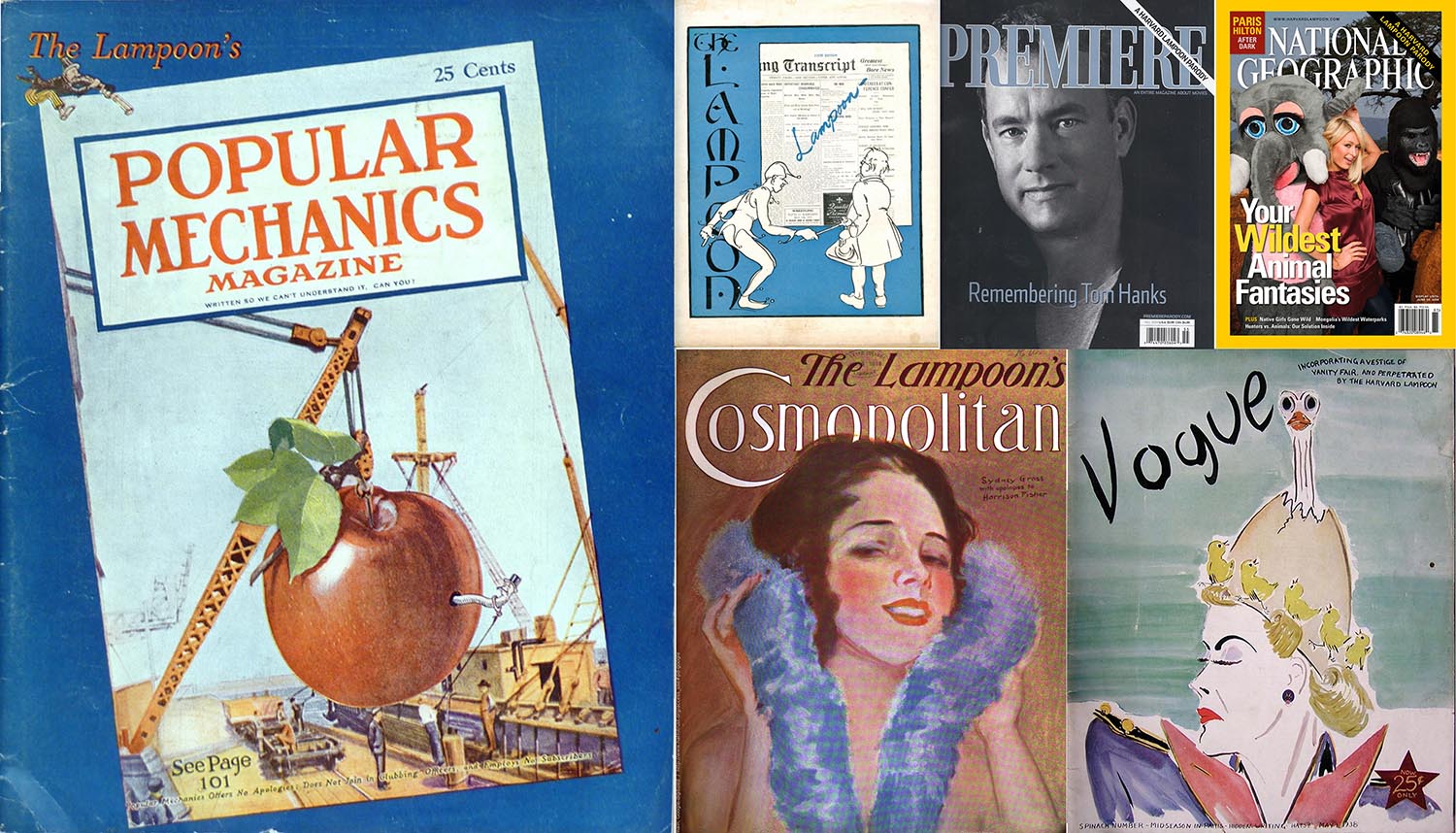
Covers of six Harvard Lampoon parodies

Clockwise from left: Lampoon parodies from 1920, May 1919, 2005, 2008, 1938 and October 1919.

I’ll bet the Harvard Lampoon has snagged more publicity for its parody issues over the years than all other humor magazines combined, but neither The Harvard Lampoon Centennial Celebration (1973) nor 100 Years of Harvard Lampoon Parodies (1976) bothers to list them all. Here’s what I’ve pieced together from these and other sources.

This list is of full-length national magazine and newspaper parodies only. It doesn’t include (a) short parodies inside regular issues, such as the five-page New Yorker spoof in the Jan. 17, 1935 Lampoon; or (b) parodies of on-campus publications such as H-Bomb, the Advocate and especially the Harvard Crimson (takedowns of which are “occasionally supplied to the student body in deference to overwhelming demand,” if 100 Years… is to be believed).

Life, March 3, 1911 (the old humor mag, not the Time Inc. version)
The Saturday Evening Post (and others?), __ 1912
Vanity Fair, April 6, 1917
The Boston Evening Transcript, May 9, 1919
Cosmopolitan, October 24, 1919
Popular Mechanics, October 29, 1920
Ladies’ Home Journal, __ 1921
Town & Country, January 31, 1923
St. Nicholas, March 27, 1924
Literary Digest, April 15, 1925 (two printings, the second censored)
Photoplay, April 1926
The Wonder Book, April 13, 1927
The New Yorker of Boston, April 19, 1928
The Sportsman, April 18, 1929
The Illustrated London News, April 17, 1930 (misdated 1920 on cover)
Liberty: April 16, 1931
Harvard AA News, November 19, 1931 (AA = Athletic Association)
Harvard Alumni Bulletin, April 15, 1932
Babies, Just Babies, January 19, 1933 (called “Tutors, Just Tutors”)
Fortune, May 1933
The Boston Daily Record, May 8, 1934
Esquire, April 1935
The Saturday Evening Post, April 23, 1936
Cosmopolitan, April 1937
Vogue, May 4, 1938
The New Yorker, May 6, 1939 (Celebration calls this the first parody to “imitate an entire format including advertising layout”)
Ladies’ Home Journal, April 1940
Time, April 8, 1941
P.M., April 30, 1942
Washington Pie, April 30, 1943 (a parody without a subject; 100 Years… says this was “so realistic it fooled most people into thinking there actually was such a magazine”)
Newsweek, April 14, 1947
The New Yorker, May 15, 1948
Pontoon, fall 1950 (parody of a typical college humor mag)
Punch, December 17, 1950
Newsweek, March 22, 1956
Saturday Review, January 23, 1961
Mademoiselle, July 1961 (in Mademoiselle)
Mademoiselle, July 1962 (in Mademoiselle)
Esquire, July 1963 (in Mademoiselle)
Time, May 31, 1965
Playboy, Fall 1966
The New York Times, March 7, 1968 (fake front page wrapped around a year-old real Times; local distribution only)
Life, Fall 1968
Time, Fall 1969
Cosmopolitan, Fall 1972
Sports Illustrated, Fall 1974
People, Fall 1981
Newsweek, Fall 1982
USA Today, Spring 1986
Time, Spring 1989
Forbes, Fall 1989
Dartmouth Review, April 1992 (local distribution, plus Dartmouth)
Entertainment Weekly, Fall/Winter 1994
Premiere, Fall 2005
National Geographic, April 2008

— VCR
“The New Times,” 1794

The Times' self-parody 1974

The Times parodies itself, 1794

Parody Of: The Times (London). Title: “The New Times.”
Parody By: The Times — and the Tories.  Date: Sept. 6, 1794. Pages: 1.
Availability: Reprinted much reduced but still legible in The History of the Times, Volume I: The Thunderer in the Making (London: Times Publishing Co., 1935).

The earliest known parody of a specific publication was a full-page self-parody in The Times of London on Sept. 6, 1794.  Like the Boston Globe’s April 2016 vision of Donald Trump as president, “The New Times” was set in a future dominated by the worst imaginable leadership — in this case, French revolutionaries and their English sympathisers. Reformers across Europe had hailed the French Revolution in 1789, but after five years of guillotines and chaos most Britons considered it a Bad Thing. So did The Times, which was only nine years old in 1794 but had already adopted an omniscient tone and an unswerving conservatism.

“The New Times” filled all of page 3 of the four-page Times, displacing the usual news and commentary. Like The Times‘s real front page, it consisted mostly of government announcements, theatrical notices and ads. Instead of the customary lion and unicorn in the real Timess nameplate, “The New Times” displayed a guillotine surrounded by crossed pikes hoisting the cap of liberty and a blood-dripping severed head. The paper’s date was given as the “First Year of the Republic, one and indivisible, Saturday, June 10, 1800.”

In the 1800 of “The New Times,” pubs serve wine instead of beer, Parliament has been destroyed, and St. Paul’s Cathedral has been converted into a “Temple of Reason.” A brief notice celebrates the discovery of a method for “making bread of decayed bones,” and the shipping news blandly records the arrival of “a French brig, laden with guillotines for use of the fleet.”

An exchange-rate table from "The New Times"

In the 1800 of “The New Times,” zero interest in the pound.

The humor of “The New Times” is pitch-black and savage, and much is still funny in an Onion-like way. The dozen or so English radicals mocked by name in its columns were probably less amused, since many of them were awaiting trial for High Treason. These included the well-known polemicist John Horne Tooke and the left-leaning Unitarian minister Jeremiah Joyce, who was depicted in “The New Times” celebrating the destruction of Parliament. (Fortunately, all were eventually acquitted.)

Real Times front page from 1794.

The real Times in 1794.

The inclusion of Tooke, Joyce and other defendants was no accident, for “The New Times” was created by the same government that prosecuted them. The parody’s author is unknown, but the official History of The Times says it was sponsored by Henry Dundas, first Viscount Melville, who was Home and War Secretary under William Pitt and head of the Tory Party’s dirty tricks division. According to scholar Marcus Wood, Pitt and Dundas “built up a propaganda machine which attempted to discredit radical thought and to magnify the dangers of radical activity.” It seems to have worked: The Tories came to power in 1783 and held it for the rest of the century.

Much of Dundas’s propaganda was slipped to friendly newspapers, who published it unaltered; in return, the papers received inside scoops, government contracts and other goodies. Times founder and publisher John Walter, for example, was appointed Printer to His Majesty’s Customs and given 300 pounds a year. “The tradition of journalists selling their consciences to politicians was old when Walter established his daily newspaper, and its age had deprived it of infamy,” the anonymous author of the History noted dryly. Infamous or not, one fruit of that tradition was the first high-profile newspaper parody. —VCR

The Intro and the Outré

For years I searched for a website devoted to magazine parody and couldn’t find one, so I’ve decided to fill the gap myself. Granted, it’s not a huge gap: Magazine parodies — and their older sibling, newspaper parodies — are just a fraction of all parodies, and parody is only one of many forms of satire, which is itself a minority taste. But I hope this blog will appeal to the thousands — or dozens — of people out there who delight in fake issues of real publications. You know who you are.

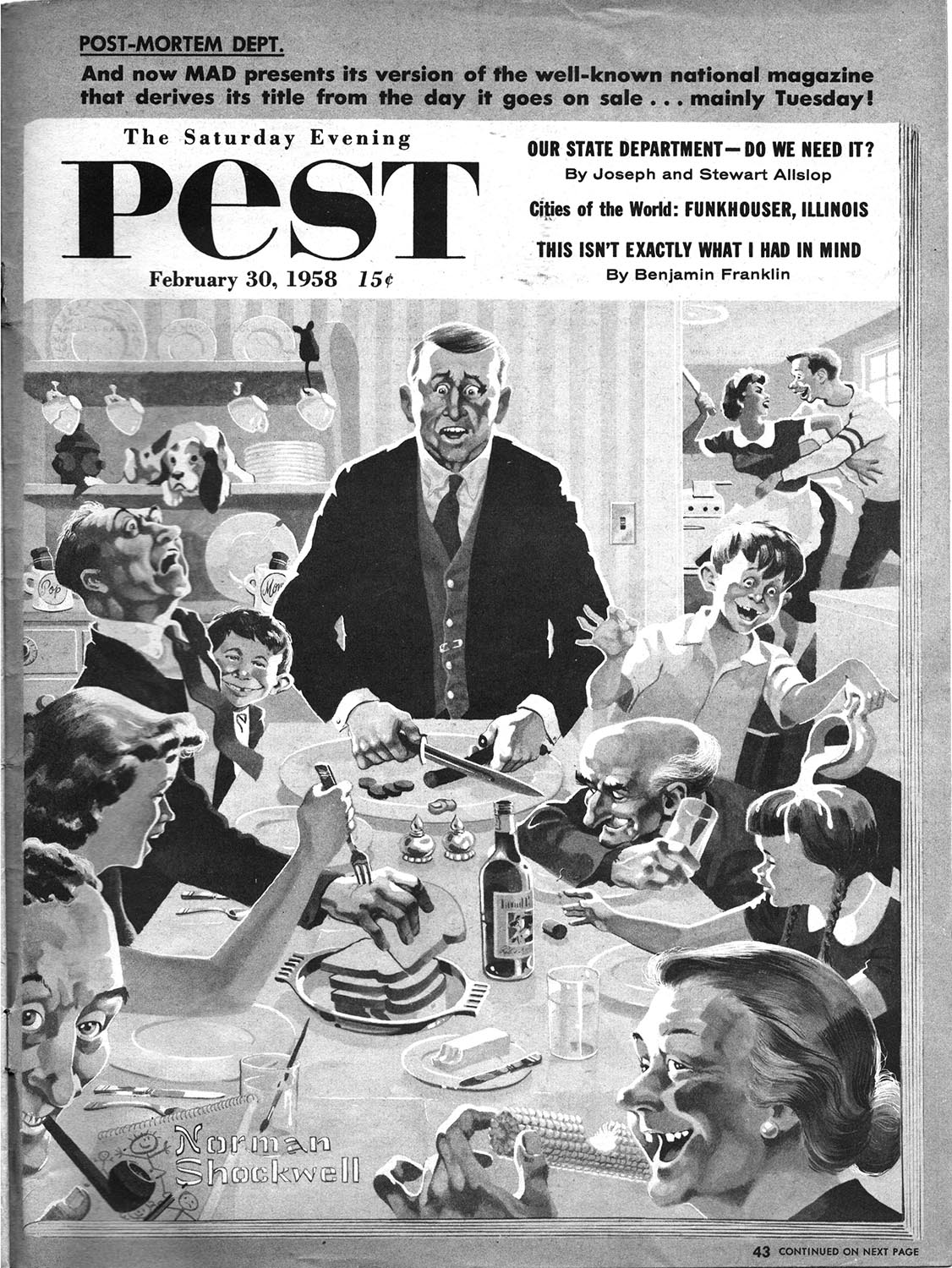
The Cover of Mad's Post

Mad #39, page 43

I saw my first magazine parody at age 10, when “The Saturday Evening Pest” in a friend’s copy of Mad #39 gave me an early lesson is pop culture deconstruction. I was a senior in high school when the Harvard Lampoon‘s “Pl*yb*y” changed the parody game in 1966, and an undergraduate when ‘Poonies Doug Kenney and Henry Beard produced three of the finest college parodies ever: “Life” (1968), “Time” (1969) and “Bored of the Rings” (1969). By the time National Lampoon launched in 1970, I was hooked on parodies. Since then, I’ve acquired or examined nearly a thousand, ranging from the “The New Times” in the 18th century to this year’s spoofs of the Boston Globe and Time with would-be president Donald Trump.

The goals of this blog are:

  • to explore the origin of newspaper and magazine parodies in England and their evolution in the United States;
  •  to discuss specific parodies and supply a taste of their contents;
  • to connect fans of magazine and newspaper parodies with each other;
  • to answer readers’ questions about them, and solicit answers to my own;
  • to collect, piecemeal, all the writing I’d better start doing right now if my carefully researched, fully illustrated, long-postponed book on magazine and newspaper parodies is ever going to become a reality; and…
  • to attract the eyeballs of everyone likely to buy such a book, so when it finally comes out I won’t have to hunt all over for you.

If the last bullet-point seems mercenary, relax. This blog exists to celebrate magazine and newspaper parodies, not to sell them — or anything else. (Amazon, eBay and abebooks exist for that.) I’ll consider myself amply rewarded if parody aficianados find the site useful and casual visitors find it diverting. — VCR