The Record mocks Click (1939), True (1963), Film Fun (1927), Esquire (1955) and movie mags (1947).
The Yale Record was founded in 1872 and likes to call itself “the nation’s oldest college humor magazine,” but its no-nonsense title gives the game away. It really started out as “a Godawful boring weekly news sheet” that used humor mostly as filler, according to author and 1991 Yale grad Michael Gerber. The jokes slowly took over, a feathered mascot named Old Owl wandered in, and by the end of the century “the Record had transformed into that familiar dog’s breakfast, the college humor magazine.”1

Grossman’s 1960 “Timf” cover.
Such mags boomed after World War I. By 1922 there were over a hundred, and for the next four decades the Record was one of the best. Its chief glory was a string of great cartoonists: Peter Arno in the ’20s (when he was Curtis Arnoux Peters); Robert Osborn in the ’30s; Robert Grossman, William Hamilton and Garry Trudeau in the postwar decades. Its writers included Stephen Vincent Benét, Dwight Macdonald, C.D.B. Bryan and the Firesign Theatre’s Philip Proctor and Peter Bergman.
The Record easily survived the Depression and a three-year pause for World War II, but the ’60s brought two changes that knocked Old Owl for a loop and killed off most of his contemporaries. The first came in 1963, when the tobacco companies, hoping to preempt federal regulation, quit advertising in student publications. This proved fatal for mags that could usually pay for an entire issue with one back-cover ad for Salem or Winston. The second was the death of the old college culture of Gentleman’s Cs and secret handshakes, where helming the newspaper or debate club meant more for one’s future than making good grades. The Record was inextricably bound up in this world, and neither the reformers of the ’60s nor the studious careerists who followed them had much use for it. In 1970, the Yale Daily News bashed its rival’s latest issue as “a complete anachronism, … a museum piece of the Old Yale, a cultural monument to prep humor.”2 Soon after that bouquet, the Record sank and resurfaced only fitfully for twenty years.
The magazine returned for good in 1989 under the leadership of Michael Gerber (now its chief alumni advisor) and Jonathan Schwartz. Since then it has grown from two issues a year to six or more, and established a website, Facebook page and Twitter feed. The current press run is 500 copies — far from the 4,000 circulation of the late ’40s, but pretty good for a product available free online.

Reader’s Digest parodies from 1943 and 1967.
Parody issues were cash cows for the college mags in their heyday, and the Record was among the few that could produce a major parody every year for decades. Info on the earliest is sparse online, but by the mid-’20s the parody was as much a part of the Record’s lineup as the Freshman Issue and Graduation Number. One of the last Records before the WWII hiatus contained a note-perfect, 64-page parody of Reader’s Digest; the first postwar volume brought a famous spoof of the New York (not Yale) Daily News that sold 18,000 copies.
Other postwar highlights included 1955’s oversized, 84-page “Esquirt” and a 1960 Time parody mostly written by Philip Proctor. The Record occasionally varied its pitch by spoofing a category rather than a single title, as in 1947’s “Happy Hollywood” or 1939’s “Phlick,” a mash-up of Pic, Click and Look whose cover shows a group of bathing beauties arrestingly labelled “Marihuana Victims.” Perhaps the Record’s greatest achievement was its 1961 “Yew Norker,” in which editor Robert Grossman skillfully impersonated some two dozen New Yorker cartoonists.

Robert Grossman channels Whitney Darrow Jr. and Chuck Saxon in “The Yew Norker.”
The long parody streak ended on a high note in 1967 with another “Reader’s Dijest” even funnier than 1943’s. Michael Gerber’s 1991 parody of the short-lived National Sports Daily got the reanimated Record some good press but failed to revive the tradition: The mag hasn’t done a nationally distributed parody since. The format still works, though: In 2014 the Record printed 2,150 copies of a takeoff on its old tormentor, the News.
The following list is incomplete and, for early years, non-existent; dots (…..) indicate the most conspicuous gaps. The 1958 Yale yearbook mentions three Record parodies — of Life, Harper’s Bazaar and the Saturday Evening Post — but provides no dates. As always, I’d welcome corrections and more information. —VCR
Yale Record Parodies, 1918-2016:
Yale Daily News, in June 5, 1918
…..
College Comics (“Collegiate Comicals”), February 2, 1926
Film Fun (“Yale Record’s Film Fun Number”), April 20, 1927
Yale Daily News (“Yale Daily Clews”), June 1927
The New Yorker, 1928-29
Time, 1928-29
Physical Culture, February 13, 1929
…..
Vanity Fair, November 1933
Yale Daily News (“Yale Delayed News”), May 1934
Yale Daily News (“Yale Delay News”), June 1936
Typical pulp mag (“Real Spicy Horror Tales”), April 23, 1937
Yale Daily News, June 3, 1938
Typical picture mag (“Phlick”), February 23, 1939
Typical pulp mag (“Torrid Total War Tales”), February 12, 1941
Life (article: “The Record Goes to Wartime Yale”), in May 20, 1942
Reader’s Digest (“Record’s Digest”), March 1943
 New York Daily News (“Yale Record Daily News”), December 16, 1946
Typical movie mag (“Happy Hollywood”), November 1947
“Record Comics,” 1949 (parodies comic books &strips)
Yale Daily News, in November 1949
Typical men’s mag (“Smut”), February 1951
Yale Daily News, February 1951 [?; in YU Library catalog]
Yale Daily News, January 31, 1952
Punch (“Paunch”), December 1952
Yale Daily News, January 16, 1954
Male (“Tale”), February 1954
The Wall Street Journal (“Bald Street Journal”), in June 1954
Esquire (“Esquirt”), February 1955
Yale Alumni Magazine (“Yale Aluminum Manganese”), in June 1955
The New Yorker (“The Nouveau Yorkeur”), February 1956
New York Daily Mirror (“rorriM yliaD”), December 1956
Playboy (“Ployboy”), February 1958
Sports Illustrated (“Sports Illiterate”), February 30, 1959
Time (“Timf”), April 1960
Reader’s Digest (“Reader’s Digestion”), in September 1960
The New Yorker (“The Yew Norker”), February-March 1961
Life (“Liff”), February-March 1962
Typical opinion mag (“The New U.S.A. Fortnightly…”), October 1962
True (“Twue”), February-March 1963
Playboy (“Pwayboy”), February 1964
Sports Illustrated (“Sports Illstated”), February 1965
Yale Alumni Magazine, “Alumni Issue” 1965
The New York Times Magazine, March 13, 1966
Reader’s Digest (“Reader’s Dijest”), February (or late spring?) 1967
Yale Daily News, January 13, 1970
The New York Times, April 1, 1974
The National Inquirer, November 1, 1975
…..
The New Haven Advocate (“…Abdicate”), April 1990
The National Sports Daily, April 1991
The Yale Herald (“…Harold”), April 1992
…..
The New York Times website, April 1, 1999 (online here)
Cosmopolitan (“The Please Your Man Issue”), April 2009
…..
Yale Daily News (“Yale Daily Record”), April 10, 2014
Yale Daily News (“Yale Daily Record”), May 6, 2016
[Edited October 9, 2021, to add a few items and remove one: The Retraction (1989) was not a parody but a Yale humor mag in the late 1980s.]
___________________________
- Michael Gerber, “The Yale Record: A Short History of its Rise, Fall and Rise Again,” on Scribd .
2. Jeffrey Gordon, “Off the Record,” Yale Daily News, Dec. 3, 1970, p. 2.

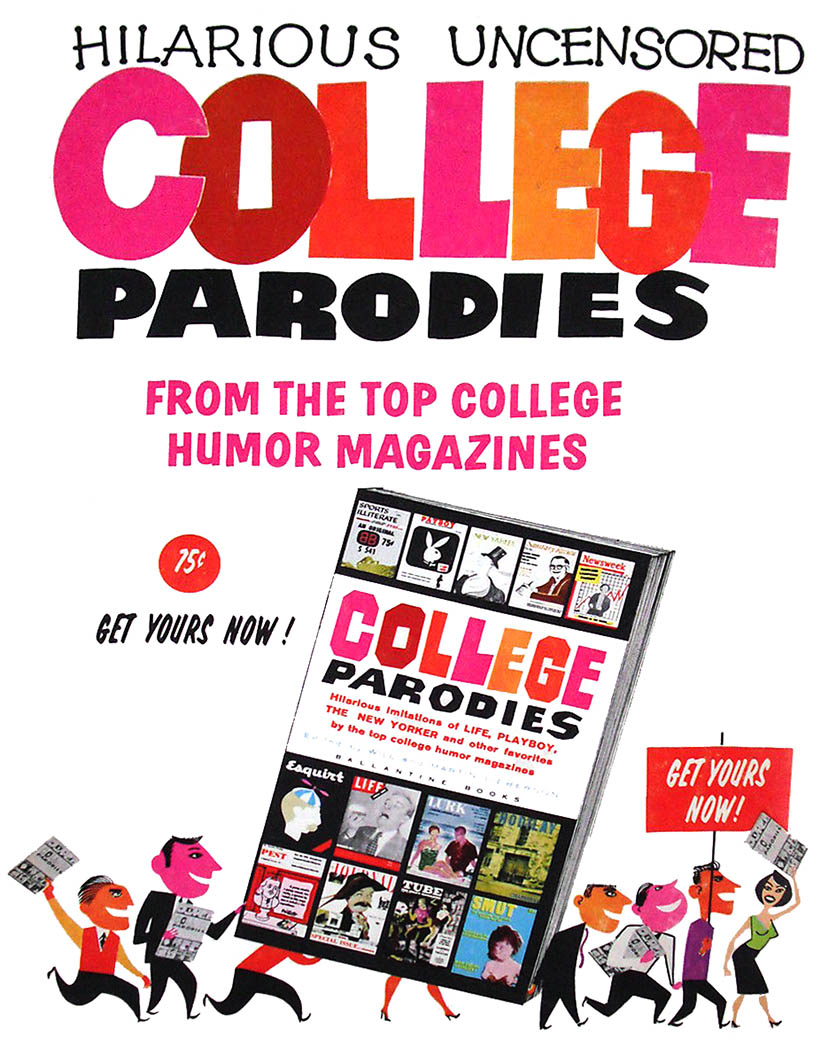
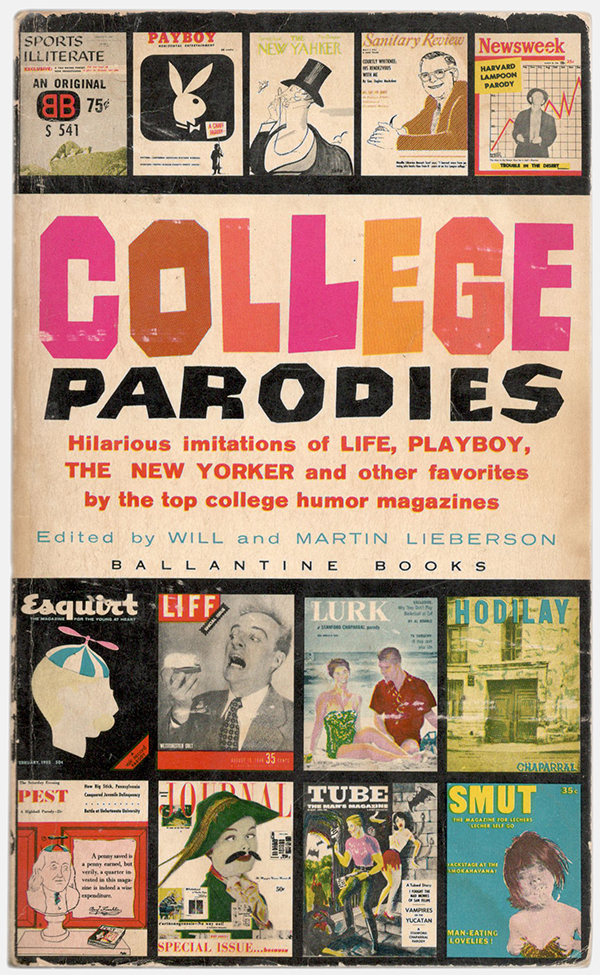
 “Smut,” which appeared as an oversized insert in the February 1951 Yale Record, might strike current readers as a general spoof of early-’50s newsstand sleazery. In fact, it faithfully apes a short-lived subset of men’s mags with names like Hit!, See, Laff and other punchy monosyllables. These titles borrowed their size and format from Life and sometimes claimed to be picture newsmagazines, but their true forebears were the Police Gazette and interwar gags-and-gals books like Captain Billy’s Whiz-Bang and the Calgary Eye-Opener. Their habitats were all-male environments like barber shops and fraternity houses, and their main draws were pictorials centered on the doings of strippers, bathing beauties, lingerie models and other females willing to show some leg. Such educational features were surrounded by dubious mail-order ads, suggestive cartoons, he-man tales of the “Weasels Ripped My Flesh” variety and shocking exposes of the Rich and Famous. All but the cartoons are gleefully mocked in “Smut.”



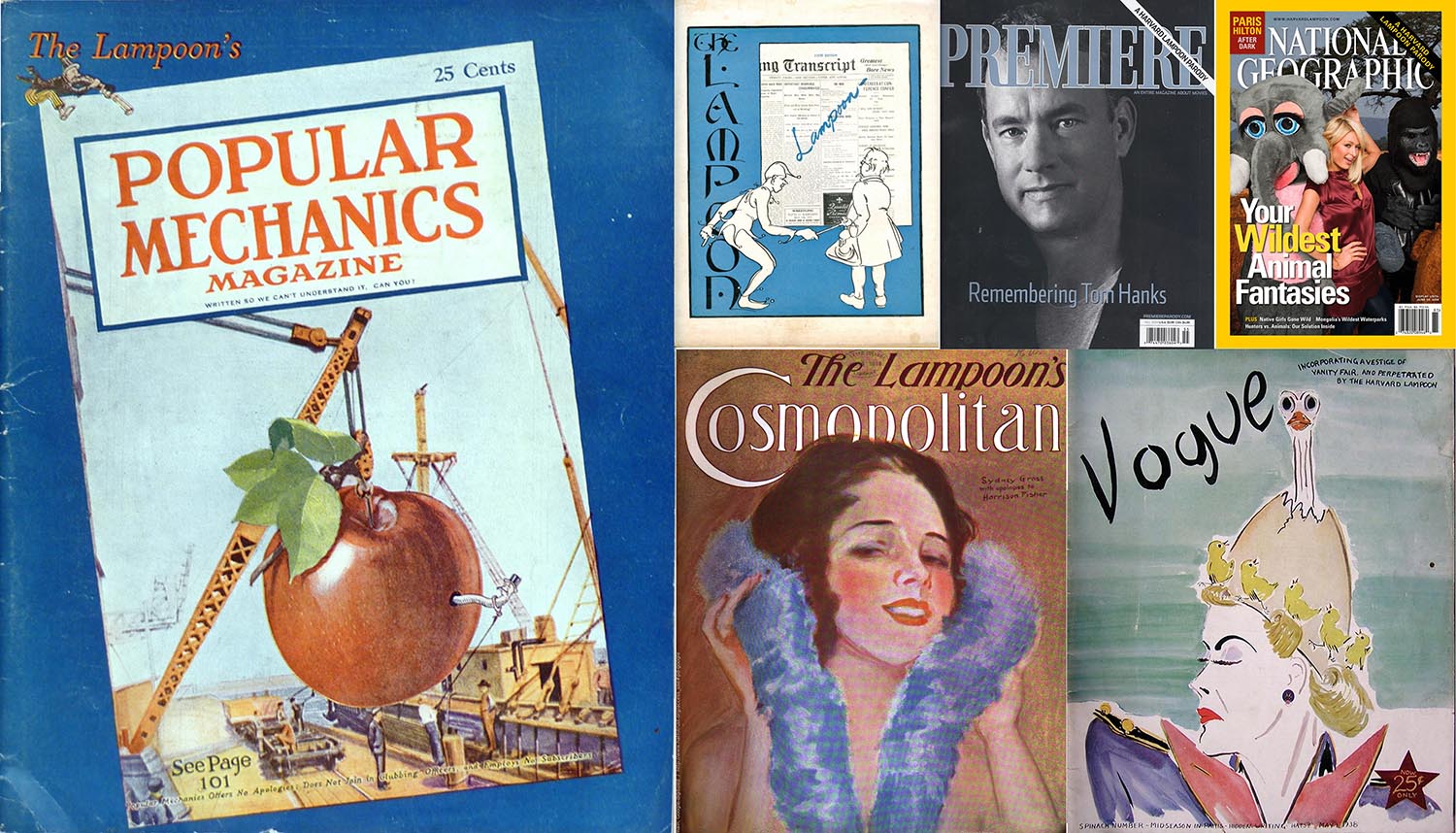
 The Harvard Lampoon may be the source of the “annual” misapprehension. Early on, its parodies really did appear every year: 27 in the quarter-century from 1919 to 1943. (Here’s a

 Aardvark was going to be the humor magazine at Chicago’s Roosevelt University until the Powers That Be saw the first issue. Shut out at home, founders Jeff Begun, Ron Epple and Howard R. Cohen decided to broaden their reach to all the city’s campuses. Aardvark survived for at least 11 issues (the last I know of is Vol. 3, no. 2, from 1964) and at its peak was distributed from Madison to Urbana. Its strengths were sharp writing and smart interviews with humorists including Mort Sahl and Shel Silverstein; its handicaps included cheap paper, sloppy layout and ugly columns of typewriter-font text.


 The Dartmouth Jack-O-Lantern‘s “Nü Yorker,” unlike the Purple Parrot‘s, is all fake and strictly for laughs, from Jerry Lewis’s letter to the editor (“I respectfully request … that neither my social security number, nor a photostat of my birth certificate be reprinted in any subsequent issues”) to the caption contest featuring Jacko‘s favorite running gag, “Stockman’s Dogs” (two canines drawn in 1934 and present in nearly every issue since). Notably funny pieces include “Letter From A Truck Stop Outside Neola, NE: This Place Sucks”; a deranged “Profile” of a poor guy named Jack Napier who can’t convince the author he’s not the Joker; and a wonderfully pretentious poem, “Skipping Cultural Stones on the Sea of Aspersions.”