Parodists and Copycats

Covers of Time and Cavalier

Time and its U.K. wannabe Cavalcade in 1937.

When is a parody not a parody? When it’s a straight-faced, money-grubbing imitation, according to the courts. Lawsuits over parodies of copyrighted works are rare and their outcomes unpredictable, but two things any accused parodist better be able to show are (1) that no reasonable person could mistake the parody for the Real Thing, and (2) that the parody hasn’t cut into the Real Thing’s sales. The easiest way to avoid this fix is to make the parody as unlike its target as possible, but that rather defeats the purpose. So parodists find themselves sweating to duplicate the look and tone and subject matter of a particular publication, while at the same time making clear to the even densest readers that what they’re holding isn’t that publication. It’s a rare and delicate art, and it’s how parodists justify their massive paychecks (joke).

Playboy and Gallery covers

May 1972 Playboy and the November 1972 debut issue of Gallery.

Occasionally, however, some enterprising pirate cuts through the niceties and kidnaps a format in broad daylight, strictly for profit. In 1972, a businessman named Ronald Fenton launched a men’s magazine called Gallery, with lawyer F. Lee Bailey as figurehead publisher. “Fenton not only copied the Playboy formula — he copied the magazine line for line, picture for picture, party joke for party joke,” Aaron Latham wrote in New York soon after the first issue appeared. “The only thing he changed was the name” — and even there he made sure to imitate Playboy’s distinctive logo. Time cracked that Gallery was “perhaps meant to be mistaken for [Playboy] on newsstands by the nearsighted,” and said Hugh Hefner’s lawyers were inspecting the first issue for possible copyright infringement; even Bailey thought the mag was too obviously a Playboy clone. “Gallery’s next issue is to be partly redesigned,” Time noted, “but Fenton is unworried. ‘All magazines,’ he says blandly, ‘have similarities.'”

Covers of Reader's Digest and Conservative Digest

The Digest and its “pure chance” lookalike (from Tom Crawford’s  Legal Guide for the Visual Artist).

Hefner chose to ignore Gallery, which soon shed its Playboyish pretensions and became just another skin mag. Giant Reader’s Digest (circulation 17 million) wasn’t so sanguine in 1985, when a small Colorado-based monthly named Conservative Digest (circulation 15,000) shrank its page size and began printing its table of contents on the cover. Though the contents were back inside after two issues, Reader’s Digest sued for copyright and trademark infringement anyway and asked for $1.2 million. In June 1986 U.S. District Court Judge Gerhard Gesell found that Conservative Digest had “copied Reader’s Digest’s trade dress in a manner which created a likelihood of confusion,” but awarded the larger magazine only $500 for trademark infringement and nothing for actual damages. Gesell reproved the big Digest for “relentlessly” pursuing the small one, but he saved his sharpest zinger for Conservative Digest editor Scott Stanley Jr.: “Mr. Stanley … testified that he did not copy Reader’s Digest‘s front cover but by chance happened to achieve complete identity while casually developing his own ideas for a new cover using a design computer,” the judge wrote in a footnote. “This testimony, reminiscent of Greek mythology recording the birth of Athena who sprang full-grown from the head of Zeus, is not worthy of belief and is rejected.”

Dingbats from Time and Cavalcade

Dueling dingbats, Time’s on top.

For truly blatant appropriation, it’s best to be outside U.S. jurisdiction altogether. Every newsmagazine since 1923 has lifted its basic format from Time, but Britain’s Cavalcade took everything else, too — from the cheeky tone and convoluted syntax to the shape of the dingbats separating short news items. Cavalcade would have been the first British newsmagazine, but editor Alan Campbell’s former employer got wind of his plans and beat him to press in early 1936 with a rival called News Review.

Inside pages of Time and Cavalcade

“Frankly plagiarizing”: March 1, 1937, Time and May 15, 1937, Cavalcade.

Time didn’t lose much sleep over either imitator, though it did call them “frankly plagiarizing” in a story on their launch. It was especially cutting about Cavalcade’s “casual way of commenting on the parallel” in its first issue: The only mention of Time was a footnote blandly calling it “a news-magazine published in the United States.'” As a news-magazine published in Great Britain, Cavalcade lasted about two years, then became a newsprint tabloid. News Review also grew less like Time over the years and ran out of the same in 1950.

Publications that wouldn’t hesitate to sic the law on imitators tend to tolerate parodists because it makes them seem good sports, because parodists aren’t rich, and because parodies usually have the word PARODY printed on them in great big type. Unlike copycats, parodists want buyers to know they’re getting a spoof — especially if the spoof costs more than the real thing. (In 1982, some newsstands mistakenly sold the $2.00 “Off The Wall Street Journal” as the real Journal, price 50 cents.) Most importantly, parodies are one-shots, usually gone by the time the Real Thing’s next issue hits the stands. But when they’re done right, one is enough. — VCR

Esquire’s “Ladies Whom BeCause,” 1962.

Ladies Whom BeCause cover

Parody Of: McCall’s / Ladies’ Home JournalTitle: “Ladies Whom BeCause.”
Parody In: Esquire.  Date: July 1962. Pages: 7. Contributors: Howard Zieff (photos), John McCray (art); no writer credits. Availability: Not hard to find.

Esquire cover, July 1962.

Esquire, July 1962.

Every so often, a magazine develops an unexpected craving for parodies, features them for a few years, then moves on. Take Esquire: Starting with “BeCause” in 1962, over the next 12 years it parodied Mad, Scientific American, The Saturday Evening Post, Ms. and People. It also imagined some unlikely newstand nuptials (“I, Playboy, take thee, Reader’s Digest…,” August 1965) and swiped Playboy’s “Interview” format for a chat with Hugh Hefner (December 1970). The most elaborate take-off ran in the December 1969 issue: an eight-page preview of The New York Times for November 8, 1976. One prescient feature caught up with former President Nixon, who had resigned halfway through his second term.

Esquire's full-page boiling water photo.

Fun with water in “BeCause.”

Esquire’s editor for most of this period was Harold Hayes, who had edited the student magazine at Wake Forest in the late ’40s, but the uncredited brains behind “Ladies Whom BeCause” were most likely David Newman and Robert Benton, two young editors who worked well as a team and had similar senses of humor. (They later went to Hollywood and grabbed the brass ring on their first try with the screenplay for Bonnie and Clyde.) Newman cut his editorial teeth at the Michigan Gargoyle in the mid-’50s, and Benton was a veteran of the Texas Ranger. They handled Esquire’s annual college issue and came up with a number of college-mag-like features, including the Dubious Achievement Awards and the March 1967 parody, “Sceintific [sic] American.”

As its name suggests, “Ladies Whom BeCause” is a mash-up of Ladies’ Home Journal and McCall’s, mostly the latter. Founded in 1873, McCall’s was the oldest of the “seven sisters” women’s magazines* but consistently played second fiddle to the Curtis Publishing Company’s Journal. That changed in the late 1950s, after art director Otto Storch gave McCall’s a major redesign emphasizing full-page illustrations closely integrated with headlines and text. “Mr. Storch used a variety of photographic processes to make type twist, turn and vibrate in the days before computers made such special effects commonplace,” Steven Heller wrote in Storch’s New York Times obituary. The look was widely imitated and proved popular with readers; in 1960, McCall’s passed the Journal in circulation for the first time ever.

John McCray's art for Ladies Whom BeCause

John McCray’s double-page pastiche of illustrator Brian Sanders in “Ladies Whom BeCause.”

Real Brian Sanders art from the '60s

Real Sanders art from the ’60s.

Like its targets, Esquire was Life-sized in the ’60s and had room to mock these innovations in all their wide-screen splendor. An article titled “22 Fun Things to Do With Boiling Water” deploys a few skimpy lines of text on a full-bleed photo in a triumph of presentation over content. That goes double, literally, for John McCray’s two-page illustration for the inevitable boy-meets-girl short story, where the central couple almost disappear in a gray-green subway station painted in the classic ’60s style of Brian Sanders. (Sanders’s art is so closely associated with the era that AMC hired him forty years later to do posters for Mad Men.)

Real McCall's cover for December 1961

Real McCall’s cover, Dec. 1961.

Not all the jokes are visual. “What is your own personal definition of an isosceles triangle?” one reader asks advice columnist “Sen. Mildred H. Pauling,” who gives an equally “personal” reply. A vacuous gossip column by “the Duchess of Mortmain and Avon” kids its targets’ longtime weakness for Big Name contributors with little or nothing to say. Even the hyperventilating cover text echoes that on the real McCall’s cover the previous December, and needs only slight exaggeration to become pure blathering giddiness. (In fairness, McCall’s editors seem to have been having the same kind of fun themselves.)

Parodists, most of them male, have been mocking magazines for women since at least the 1920s, often with a heavy overlay of clueless condescension. “Ladies Whom BeCause” isn’t free of such blemishes, but it partly compensates for them by being impeccably dressed. — VCR

—————————————-
* The others: Ladies’ Home Journal (1883-2014), Good Housekeeping (1885- ), Redbook (1903- ), Better Homes & Gardens (1922- ), Women’s Day (1931- ), Family Circle (1932- ). McCall’s died in 2002, two years after Rosie O’Donnell was named editorial director and one year after its name was changed to Rosie.

William Hone’s “A Slap at Slop,” 1821.

Front page of A Slap at Slop.

Parody Of: The New Times (London). Title: “A Slap at Slop.”
Parody By: William Hone. Date: 1821. Pages: 4.
Contributors: William Hone (writer), George Cruikshank (art).
Availability: PDF of pamphlet version online here.

Portrait of William Hone

William Hone, 1780-1842.

William Hone may have been the original pop-culture fanatic. Born in London in 1780, he was drawn to the printing trade and radical politics while still in his teens. In the 1790s he was a disciple of free-thinker William Godwin and briefly belonged the London Corresponding Society, one of the pro-French groups targeted in The Times’s 1794 self-parody, “The New Times.” In 1810, he began writing and publishing attacks on the authorities that were scathing, witty and abundant — 175 separate titles between 1815 and 1821.

Hone collected printed ephemera most of his life, from old-master prints to election handbills, and he was fascinated by parodies. He loved to present his radical satires as if they were children’s stories, advertising circulars and — most notoriously — books of religious instruction. Around 1817, he issued three political satires modeled on three core documents of the Church of England: the Catechism, the Liturgy and the Creed. In one, “The Late John Wilkes’s Catechism,” he even parodied the Lord’s Prayer: “Our Lord who art in the Treasury, whatsoever be thy name, thy power be prolonged, thy will be done throughout the empire, as it is in each session. … Turn us not out of our places; but keep us in the House of Commons, the land of Pensions and Plenty; and deliver us from the People. Amen.”

Seeing an opening, the Tory government charged Hone with three separate counts of blasphemy, claiming it was prosecuting him not for his politics but for mocking religion. The trials were held on consecutive days in December 1817, all before the same judge but with different juries. Acting as his own lawyer, Hone won three acquittals and national fame as a champion of free speech. His most effective tactic was showing jurors dozens of religious parodies similar to his own that had not been prosecuted. Collecting these whetted his interest in the subject, and he spent the next 20 years gathering material for a book. Unfortunately, the book never materialized, and his collection disappeared after his death in 1842.

Hone's Buonaparte-phobia

“Buonaparte-phobia.”

Hone never copied a specific publication in detail, but a few times he came close. One such was “Buonaparte-phobia, or Cursing made Easy” (1815), a half-sheet poster mocking The Times’s nonstop abuse of Napoleon. Hone made The Times look ridiculous simply by knitting the more spittle-flecked passages of its anti-Boney editorials into one 3,000-word rant. He attributed these attacks to a “Dr. Slop,” after the incompetent obstetrician in Tristram Shandy, but their real author was a quarrelsome and widely disliked reactionary named John Stoddard. Originally a lawyer, Stoddard began contributing to The Times in 1810 and was named editor in 1814. His duties included writing the “leading article” (i.e., lead editorial), but his “style was as violent as it was personal,” the paper’s official history said: “In 1814 The Times was ridiculed as a magazine of curses.” Essayist William Hazlitt, who despised Stoddard’s politics despite (or because of) being his brother-in-law, wrote in 1823 that Stoddard’s Times “might be imagined to be composed as well as printed with a steam engine.”

The Times axed Stoddard at the end of 1816, suspecting him of disloyalty. Two months later, he reappeared as editor of a rival paper, The Day, which he soon renamed The New Times (no kin to the 1794 parody); the real Times sniffily dismissed it as “the New, or Mock, Times.” In 1820, Hone renewed his attacks on Stoddard with a reprint of “Buonoparte-phobia,” followed by a four-page, broadsheet parody of The New Times titled “A Slap at Slop and the Bridge-Street Gang.” (The latter was a pro-government propaganda group whose real name was the Constitutional Association for Opposing the Progress of Disloyal and Seditious Principles.)

Slap at Slop pages 2 through 4

“A Slap at Slop,” first edition, pages 2-4.

Like the 1976 film Network, “A Slap at Slop” anticipated media trends that seemed outlandish but later became standard. Its front page consisted entirely of ads, as was the custom, but Hone gave them the bold headlines and large illustrations previously seen only in posters and handbills. “My first intention was to parody Slop’s paper, ‘The Slop Pail,’ or ‘Muck Times,’ throughout,” Hone wrote. “But … what could I do with thoughts as unquotable, as confused, as ill-conceived, as ill expressed as that puissant Lord’s — without depth or originality — as plentiful and superficial as duckweeds…. Under the stringent necessity of varying my original plan, … I have parodied some of the features common to the Slop Pail, and supplied … a Sketch of HIS LIFE — filling the remainder of the sheet in my own way.” In that sketch, Hone described Stoddard as a man who “mistook passionate heat for the enthusiasm of genius, a habit of loud talking for talent, a ranting way of writing for reasoning, and pertinacity of manner for firmness of character.”

Hone’s “own way” ranged from pure nonsense to blackest humor: One fake ad pictured the Duke of Wellington, hero of Waterloo and current Tory leader in the House of Lords, as a turbaned “Indian juggler” forcing Britannia to swallow his sword. “Wanted To Go Abroad,” said another ad, “a stout, active, stone-hearted young man, of a serious turn, as an apprentice in the military business, and to assist as a missionary. Apply at the Bishop and Bayonet, Westminster.” Directly below that was a picture of “A Nondescript” — a creature made up of mitres, crowns, boots and other symbols of authority — accompanied by several hundred words of pure gibberish.

Real and fake Warren's Blacking ads

A real Warren’s Blacking ad (left) and the “Slap’s” parody, both drawn by George Cruikshank.

The “Slap” also contains the earliest known parody of a national ad campaign. Robert Warren’s Shoe Blacking had made itself famous with a drawing of a cat startled by its own reflection in a freshly polished boot. In Hone’s version, a rat sees himself wearing a judge’s wig — a hit at politician Charles Warren (no kin to Robert), a former radical who had cynically turned Tory in exchange for a Welsh judgeship worth 1,000 Pounds a year. The fact that one of the Tory leaders had given his name to the Wellington boot must have been an irresistible set-up for Hone and his illustrator, cartoonist George Cruikshank. It didn’t hurt that Cruikshank had also drawn the original ad.

Cruikshank cartoon of Southey and Prince of Wales

Poet Laureate Robert Southey and King George IV, as seen by George Cruikshank.

On inside pages, Hone parodied Robert Southey’s overblown ode to the late King George III, “A Vision of Judgement,” as “A Vision of Want of Judgement.” Southey was a fire-breathing radical who moved right relatively young; by 1813 he had ingratiated himself with enough Top People to be named Poet Laureate, much to his old comrades’ disgust. Cruikshank’s illustration shows the poet serenading his new muse: an overweight, underdressed  George IV strumming a lyre. Hone also mocked Southey’s naked careerism in an ad for “Golden Ointment for the Eyes,” which the poet testifies is “astonishing! I immediately looked two ways at once, and saw my way clear to the Laureateship. I have seen in the dark ever since!”

Topical humor seldom outlives the issues that inspired it, and many of the jokes in “A Slap at Slop” have become the stuff of footnotes. What comes through undiminished is the force of Hone’s personality. He hated unearned privilege, militarism and servility, and he loved working people, old paper, liberty and forceful writing. And he really, really, really didn’t like John Stoddard. — VCR (edited 4/11/18 to correct info on Charles Warren)


Stanford Chaparral Parodies, 1915-2008.

Covers of five Stanford parodies

Clockwise: Parodies of the Stanford Sequoia (1915), horror pulps (1941), Saturday Evening Post (1954), Look (1955) and Ladies’ Home Journal (1951).

The Stanford Chaparral was the first successful college humor magazine outside the Ivy League. Recent grad Everett W. Smith and senior Bristow Adams put out the first issue in October 1899; they also gave the magazine its mascot:  a middle-aged jester in Harold Lloyd glasses called “the Old Boy.” In 1905, Judge’s Monthly listed the Chaparral and its nearby rival the California Pelican (b. 1901) among the best-known college magazines. Both remained fixtures of Top Ten polls for sixty years.

Another "new costume": 1967's "Groin."

Another “new costume”: 1967 “Groin.”

Other magazines envied the Chaparral for its plentiful advertising, professional appearance and frequent parody issues. In the April 1903 “woman’s edition,” the all-female staff briefly parodied the Ladies’ Home Journal and the campus literary magazine, the Sequoia. What may be the first issue-length parody was another Sequoia, dubbed the “Squaller,” in January 1915. “Chappie has secured a new costume,” the Daily Palo Alto wrote, as if introducing readers to an unfamiliar concept. “It is the business suit of the Sequoia. The new garments, exterior and interior, are to the exact style and cut of those of his red-jacketed companion, for his whole get-up will be a jocose though satirical impersonation.”

Cover of 1961 Layboy.

1961 “Layboy.”

The golden age for Chaparral parodies was the 1950s, which was also the heyday of Life, Look, the Saturday Evening Post, Holiday and other large-format, lushly illustrated sitting ducks. The Chaparral couldn’t match their production values, but it came closer than most college mags, especially in “Lurk” (Look) and the “Saturday Evening Pile” (the Post). The most notorious parody was 1961’s “Layboy,” a mock Playboy that got editor Brad Efron suspended and the Chaparral shut down for the rest of the year. The unluckiest was a 1981 spoof of the San Francisco Chronicle’s Sunday magazine, Datebook. Playing off the popularity of Dallas, “Datebook’s” cover asked “Who Shot RR?” over a photo of President Reagan in a cowboy hat. The magazine went on sale at 9 a.m. local time on Monday, March 30, one hour before Reagan was shot for real in Washington, D.C.

Cover of 1981 Datebook parody.

“Datebook,” in Joey Green’s
Hellbent on Insanity 
(Holt, Rinehart & Winston, 1982).

Like most campus mags, the Chaparral sputtered and stalled in the 1960s. Unlike them, it kept going, though its claim to be “the nation’s second oldest continually published humor magazine” (after the Lampoon) is a stretch: In addition to the 1961 “Layboy” hiatus, the Chaparral abandoned humor for radical politics in the Nixon era, and in the ’80s it sometimes appeared only once or twice a year. The Chaparral last made national news in 2004, when its outside-the-box parody of “A Pile of Paper” —  bills, restaurant menus, lottery tickets, etc. — was written up in The New Yorker. More recent sightings are scarce. The magazine’s Twitter account has been dormant for two years, and the most recent issue on its website, stanfordchaparral.com, is dated Sept. 2005.

This list includes all the Chaparral parodies I know of, including those of other campus publications, but it’s far from complete. I’ve used dots (….) to show the longer gaps and would appreciate help filling them. Most of the info comes from the Stanford Daily archive (online here), The Stanford Chaparral Inaugural Century (Stanford Chaparral, 1999) and my own collection.

Stanford Chaparral Parodies, 1915-2008:

The Stanford Sequoia (“The Stanford Squaller”), January 1915.
….
Judge (“Judge Bathing Girl Number”), May 1925.
Vanity Fair, January 1926.
College Humor (“College Rumor”), March 1928.
Various publications (“Parody Number”), June 1928.
Various publications (“Magazine Parody”), March 1929.
True Love / True Confessions (“True Love Confessions”), March 1930.
The Quad (“The Quid”), June 1930 [Stanford yearbook]
Typical 19th-century magazine (“The Family Gazette”), February 1931.
The Quad (“The Quid”), June 1931.
The American Weekly (“…Weakly”), March 1932.
Various campus publications, May 1934.
The Quad (“The Quid”), June 1935.
The Stanford Daily (“…Doily”), in May 1938.
Typical pulp magazine (“Horror Chaparral”), January 1941.
Various campus publications (“Minor Publications Number”), June 1942.
Life (“Like”), May 1943.
Esquire (“Chappie”), May 1945.
The American Weekly (“…Weakly”), in May 1946.
San Francisco Call-Bulletin (“Drofnats Bull-Calletin”), in May 1946.
Typical pulp magazine (“Pithy Pulp”), January 1947.
Vogue (“Vague”), March 1949.
Fortune (“Fawchun”), March 1950.
Ladies’ Home Journal (“Ladies Prone Journal”), March 1951.
The American Weekly (“…Weakly”), in May 1951.
Life (“Lite”), March 12, 1952.
The Stanford Daily (“…Dilly”), in May 1952.
Modern Screen (“Maudlin Screen”), March 1953.
Saturday Evening Post (“Saturday Evening Pile”), March 10, 1954.
Look (“Lurk”), March 9, 1955.
Life (“Li_e”), March 14, 1956.
Holiday (“Hodilay”), April 1957.
The Stanford Daily (“The Stanfraud Daily”), February 5, 1958.
Sports Illustrated (“Sports Frustrated”), April 30, 1958.
True (“Tube”), April 1959.
Saturday Evening Post (“Wednesday Morning Pile”), April 27, 1960.
Playboy (“Layboy”), May 1961.
The Stanford Daily, May 18, 1962.
This Week (“Dis Week”), June 1963.
Campus Voice (“Pompous Voice”), November 1963 [local magazine].
The Stanford Daily, April 1965.
Playboy (“Layboy”), June 1965.
Typical men’s adventure magazine (“Groin”), May 1967.
Time, May 1968 [mostly non-parody content].
Campus Report, March 1973 [Stanford faculty and staff weekly].
The Stanford Daily, Nov. 23, 1974 [distributed at Cal game].
The Stanford Daily (“Stanford Daily Wednesday”), April 7, 1976.
Highlights for Children, in November 1978.
Time [from 1984], in November 1979.
Datebook, Spring 1981 [S.F. Chronicle Sunday magazine].
Us (“Blame Us”), in June 1981.
….
The Stanford Daily, June 6, 1990.
The Stanford Daily, March 10, 1994.
San Francisco Chronicle, February 1998.
Typical lifestyle magazine (“Magazine”), March 1999.
National Geographic, April 2002.
“A Pile of Paper,” Spring 2004 [just that].
Typical thriller novel (“Mystery Thriller”), May 2008.
Stanford Daily Magazine, May 2017.
Various campus publications, June 2018  — VCR

(Updated June 12, 2021)

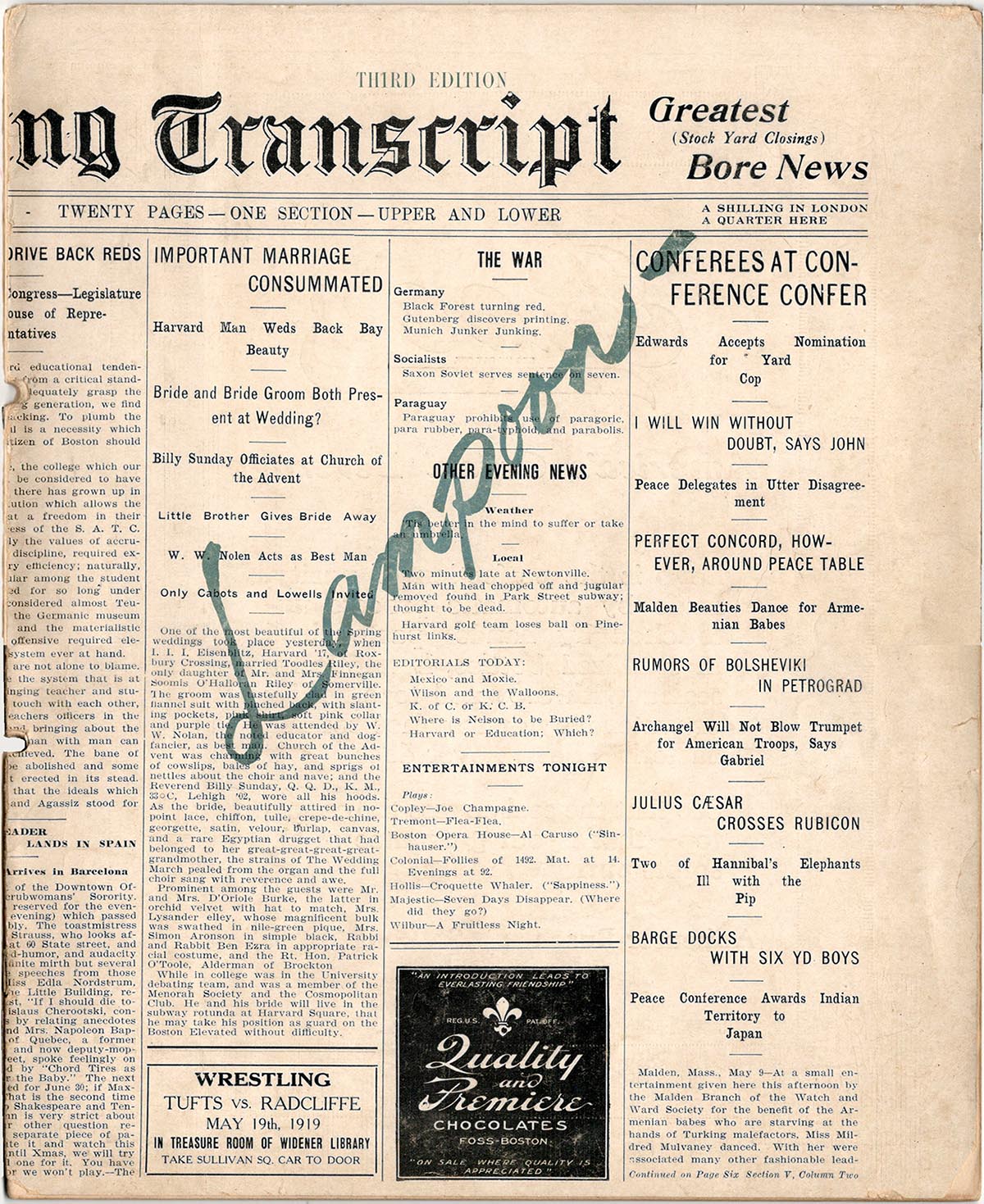
Online: The Lampoon’s “Transcript,” 1919.

Lampoon's "Transcript" cover.

Unlike later Lampoon newspapers, the “Transcript” looked like (and was) a 9″-by-11″ magazine.

Parody Of: Boston Evening TranscriptTitle: “Boston Evening Transcript.”
Parody In: Harvard Lampoon.  Date: May 9, 1919. Pages: 16 + cover.
Contributors: None credited. Availability: Online here at Hathi Trust.

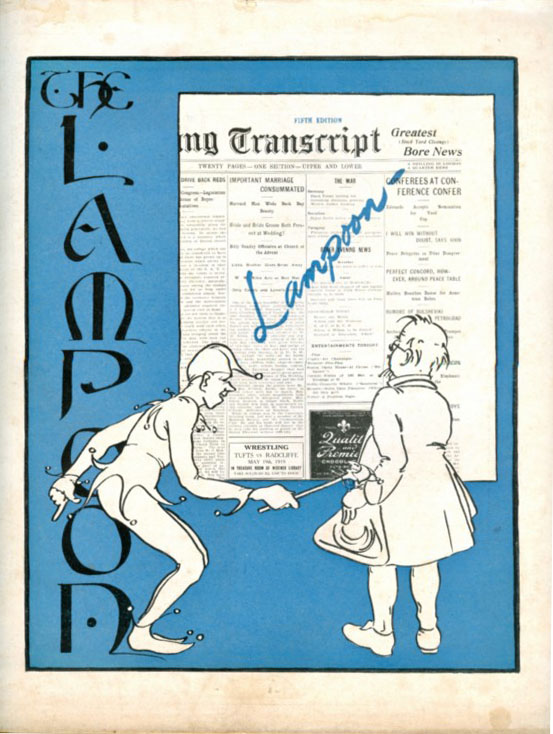
Fifth printing, new cover.

The fifth printing’s new cover.

“The old Boston Evening Transcript, conservative, delicate, dignified, and ever ‘responsible,’ served from the mid-nineteenth century until its quiet demise in 1941 as the ‘Bible of Proper Bostonians.’ In 1919 it was the unhappy subject of the one of the Lampoon’s most popular and successful parodies, which went through five printings and sold eight thousand copies, a circulation record not broken until the Literary Digest issue of 1925.” — 100 Years of Harvard Lampoon Parodies (1976), p 36.

“The Lampoon’s effort is a brilliant piece of parody. Sometimes it is a little obvious, and the number of themes upon which it lays unholy hands could have been varied with advantage. But the headlines and memorial notices are alone worth the price of admission; and the editorial is so like what the Transcript actually preaches — it is perhaps rather better written — as to suggest that it was contributed in all seriousness from the Transcript office. … But the main thing, at the moment, is to send a copy of the Lampoon to every Transcript subscriber.” — Harold J. Lasky in the Crimson, May 12, 1919.

The “Transcript” deserved its success. It was filled with the kind of collegiate whimsy the Lampoon usually disdained, and the newspaper format kept the jokes brief and frequent. The 1919-20 Lampoon staff couldn’t boast a Robert Benchley (class of 1911) or Robert Sherwood (’17), but it cemented a tradition: After the “Transcript,” the Lampoon produced a parody issue, usually in the spring, every year for the next quarter century.

The ‘Poonies weren’t the first Harvard men to mock the Transcript. Two years earlier, in Prufrock and Other Observations, T. S. Eliot (’09) had watched the approaching evening:

Wakening the appetites of life in some
And to others bringing the Boston Evening Transcript.

In his nine-line poem named for the newspaper, Eliot sketched Transcript readers as life-avoiding shut-ins. It’s simultaneously harsher and more subtle than the Lampoon’s parody, but both exploit the paper’s reputation for enervated propriety, and both succeed at what they set out to do. Prufrock and Other Observations changed the course of modern literature; the Lampoon’s “Transcript” made a lot of people laugh. — VCR

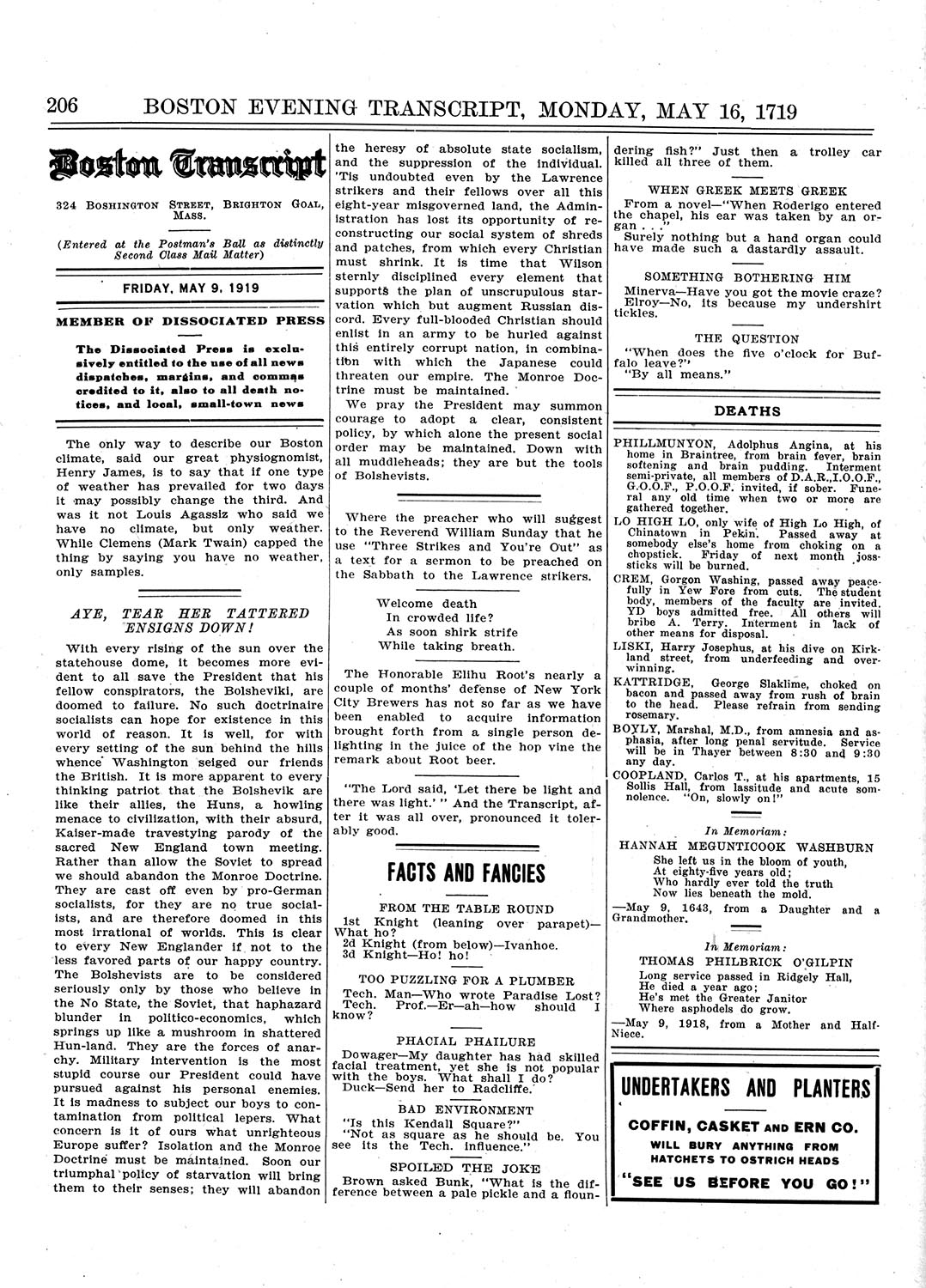
1919-Transcript-206-sm

The dead in column 3 include “Harry Josephus Liski” and other thinly disguised Harvard notables. The Lampoon repaid British socialist Harold J. Laski’s kind words in the Crimson next January, when it spent a whole issue trashing him for supporting the 1919 Boston Police Strike. The Lampoon’s own history called the Laski issue “Red-baiting,” “blatantly anti-Semitic” and “Lampy’s Blackest Hour.”

The Harvard Lampoon’s very first “Life,” 1896.

The Harvard Lampoon's first Life parody, 1896.

Parody OfLifeTitle: “Life.” Parody In: Harvard Lampoon.
Date: March 26, 1896 (Vol. 31, no. 1), pp. 10-11. Length: 1 page (on 2 Lampoon pages).
Contributors: W. Ames ’95, J.P. Welch ’97. Availability: Lampoons from the 1890s turn up periodically (pun) on the web; good luck finding specific issues.

Life, a national comic weekly founded by Lampoon graduates, was the perfect target for the very first magazine parody, which appeared in a regular issue in 1896. Later that year the Crimson was parodied for the first time and other magazines were assailed in turn by the ‘Lampy’s Contemporaries’ series.'” — Harvard Lampoon Hundredth Anniversary Issue, February 1976, p. 8.

A page from a real 1896 Life.

The real Life in 1896.

Life the humor magazine — sometimes called “the old Life” — was launched on Jan. 1, 1883 by a group of Harvard grads, two of whom, Edward S. Martin and John Tyler Wheelwright, had helped start the Lampoon seven years earlier. The two magazines stayed close: Life began as a kind of national Lampoon, so to speak, and as Life’s circulation grew the Lampoon began to resemble its offspring.

This displeased the Crimson, which wrote sternly in 1887: “The [Lampoon] is a college paper and should retain its character as such and should not aim to be a cheap copy of a paper that has no more originality or excellence than is found in Life.” The Lampoon echoed the “Crime’s” putdown of Life in the parody’s “Editorial,” which took some nerve: Life had started running one-page parodies of Punch, The New York Tribune and others under the heading “Some of Life’s Contemporaries” in 1885. The Lampoon’s only variation 11 years later was to drop “Some of.”

Two items from the Lampoon's Life.

Two items from the Lampoon’s “Life.”

Unlike its rivals Puck and Judge, which ran full-color political cartoons every week, Life stuck to chaste black and white and affected to be above party politics. Editor John Ames Mitchell advocated Good Government by the Better Sort of People, a kind of Gilded-Age version of Limousine Liberalism. He hated vivisection, child labor, and impoverished English Lords who cynically marry beautiful American heiresses for money. The last is an oddly specific issue, but Life was obsessed with it.

Cartoons from the Lampoon's Life, 1896.

The Lampoon pits Life’s Charles Dana Gibson (left) against Punch’s George du Maurier.

Robert Benchley and Gluyas Williams targeted Life’s foibles in 1911 in the Lampoon’s first issue-length magazine parody, then went on write and draw for the real thing in the ’20s. But when they and other members of Algonquin set moved to a new magazine called The New Yorker, the Lampoon’s affections followed. The Depression killed Life’s ad revenues, and it folded in 1936 after selling its name to Time Inc.’s new picture magazine for $92,000. Thirty-two years later, ‘Poonies Henry Beard, Doug Kenney and Rob Hoffman quarterbacked a parody of that “new” Life, which got them thinking of producing a second national Lampoon. It debuted in April 1970, this time with the “N” capitalized. — VCR

Spy’s 10-Magazine Parody Pack, 1991

Spy's parody of Vanity Fair and People

Vanity Fair and People as spoofed by Spy, 1991.

Parody Of (in order): Vanity Fair, People, The New Republic, Architectural Digest, Esquire, Rolling Stone, New York, GQ, New York Times Book Review, Harper’s.
Title: “Coming Soon to a Newsstand Near You.” Parody In: Spy, August 1991. Pages: 9. Contributors: Uncredited.  Availability: Not hard to find.

Spy cover, August 1991

Kurt Andersen and Graydon Carter launched Spy in 1986 as a new kind of humor magazine, one that would mock New York’s rich and powerful by snarkily dissecting their actual behavior rather than making stuff up: “Not parody, [but] satire,” the prospectus said. But parody’s ability to make satire look believable proved too tempting to resist, and after a few years Spy took to running pieces that were fact-based without quite being real, like 1990’s Annual Corporate Report from the Gambino crime family. Another, more fanciful feature (“A Casino Too Far,” August 1990) used fake newspaper clippings to show Donald Trump’s fall from mogulhood to bankruptcy over the next six years. If they’d just looked a few decades further …

Intro page of Spy article

Spy, Aug. 1991, p. 45.

Spy’s “Coming Soon to a Newsstand Near You” also peered into the future, but only a few months, and only to cover an event everyone knew was coming: the September 1991 publication of Harlot’s Ghost, Norman Mailer’s much-ballyhooed novel about the CIA. On Spy’s newsstand, Mailer’s 1,300-page gobstopper is mere grist for the editorial mill. “Harper’s” counts the book’s four-letter words for its Index. “People” probes Mailer’s love life, while “GQ” and “Architectural Digest” grade his clothing and shelter. “Esquire’s” Jim Harrison can barely hear Mailer over the burble of his own gastric juices, and “Vanity Fair’s” Nancy Collins turns what should be a portrait of the artist into an advertisement for herself. In the broadest and funniest bit, Jan Wenner drops names, diet tips and the conversational thread in a “Rolling Stone” interview with his clearly bored subject:

JW: “You know what Mick does to stay fit? One weekend a month he does nothing but drink carrot juice.”
NM: “Mick?”
JW: “Jagger.”…
NM: “The ectomorph? With the articulated rib cage?”
JW: “Yeah. Now, you wrote The Executioner’s Song, right? …

Spy's parodies of Rolling Stone and New York

Spy’s “Rolling Stone” and (inset) “New York.”

Salman Rushdie in the “Times Book Review” and Leon Wieseltier in “The New Republic” are almost as self-absorbed, though they name-check Musil and Doctorow rather than Jagger. The navel-gazing climaxes with a gossipy “New York” magazine item about the story behind Wenner’s interview with Mailer that doesn’t even mention the book. And it’s not like those who do stick to the subject have much to say: A running gag shows each publication struggling to make something out of the same ho-hum Mailer remark: “A damned fat old man, that’s what I am.”

The parodies range in length from a few sentences to double-page spreads and are visually and typographically impeccable. As always with Spy, some of the choicest bits are in the tiniest type: Headlines on fake mini-mag covers include “The 50 Greatest Fretless-Bass Players” (“Rolling Stone”) and “The Oreo Returns” (“New York”). Humor magazines regularly ran multi-title “Burlesque Numbers” like this in the 1920s and ’30s, but for some reason they fell out of favor after World War II. Spy’s “Newsstand” is proof the old formula still has life in it. — VCR

Six fake covers for Spy's parodies

Tiny covers from p. 45, enlarged.

A mysterious “Newsweek,” 1963

Newsweek's story on the parody

The real Newsweek on a “vicious” parody, Jan. 13, 1964.

Parody OfNewsweekTitle: “Newsweek.” Parody By: Unknown.
Date: “November 18, 1963.” Pages: Unknown. Contributors: Unknown.
Availability: Vanished from the face of the earth, AFAIK.

1963 fake Newsweek cover.Of all the magazine parodies I’ve heard of but never seen, 1963’s anonymous “Newsweek International Edition” is the most puzzling. Calling it “a vicious piece of propaganda,” the real Newsweek for January 13, 1964, laid out the few facts available: “Purporting to be the Nov. 18, 1963, issue of Newsweek with a cover picture of Sen. Barry Goldwater, the hate pamphlet is a mishmash of doctored photographs and inflammatory captions in French and English, apparently designed to foment race hatred and anti-American sentiment. A number of copies were mailed from Europe, but efforts to track down the publishers and distributors have been unsuccessful.”

Newsweek offered $1,000 for info leading to the perpetrators, but apparently no one collected; the magazine never mentioned the parody again. A UPI wire story from the same month said that copies “had been sent to foreign embassies throughout the world. There was no return address and the fake copies bore postmarks from different European cities.” The parody’s use of French and its focus on “race hatred” suggest it might have been intended for readers in France’s former African colonies, but that’s just a guess.

the real November 18, 1963, NewsweekI’m more confident that whoever created this “Newsweek” either hadn’t seen the original recently or assumed potential readers hadn’t. The cover resembles a typical Newsweek from 1949 or ’50, when its lopsided-red-border-and-square-photo format was new and not yet plastered with boxes and banners. Newsweek began stripping away this effluvia in 1961 and by mid-’62 was running full-bleed covers topped only by its underlined name, as in the real November 18, 1963, issue shown here. Whatever his(?) talents as a propagandist, the creator of “Newsweek” was no great shakes as a parodist. — VCR


Harvey Kurtzman’s “Sporty Illustrations,” 1957

Will Elder's SI cover in Trump #2, March 1957.

Will Elder’s SI cover in Trump #2, March 1957.

Parody Of: Sports Illustrated. Title: “Sporty Illustrations.” Parody In: Trump magazine. Date: March 1957. Pages: 10. Contributors: Harvey Kurtzman, Bernard Shir-Clif (writers), Will Elder, Jack Davis, Al Jaffee (art). Availability: Reprinted in Trump: The Complete Collection (Fantagraphics, coming August 30, 2016).

1956 Sports Illustrated cover.

Real SI, 1956.

I’ve had my hopes dashed before, but it looks like Harvey Kurtzman’s Trump is finally being reprinted 60 years after its brief run in 1956-57. Trump was the carrot Playboy’s Hugh Hefner used to lure Kurtzman and most of his artists away from Mad. The year before, Kurtzman had convinced Bill Gaines to turn Mad into a 25-cent magazine, but he still wanted more control and a bigger budget. Hefner offered both, but the sudden death of Collier’s in December 1956 spooked his bankers. Despite strong newsstand sales, Trump died after two issues, which quickly became collectors’ items. Thanks to Fantagraphics, new readers can now enjoy Kurtzman’s most elaborate magazine parody, “Sporty Illustrations.”

Launched in August 1954, Sports Illustrated was the first new magazine from Time Inc. since Life, and it took an upper-middle-brow approach to what most publishers considered a low-brow subject. Irreverent Time-Lifers christened the new mag “Muscles.” To erase that image — and the doubts of high-end advertisers — the early SI devoted as much space to yachting, ballooning, dog shows and other snooty pursuits as it did to ball games: In the first year there were two covers on bird-watching.

Two pages of Mad's article on sports magazines.

Mad #32 (April 1957), art by Bob Clarke.

All this was catnip for parodists: The Dartmouth Dart’s “Spots Illustrated” appeared just four months after SI’s first issue; by June 1956, college humorists at Valparaiso, Ohio State, Maryland and Annapolis had followed suit. Almost simultaneously with “Sporty Illustrations,” Mad #32 mocked “Sports Sophisticated” in a feature asking, “What’s Happened to Sports Magazines?”

Kurtzman gets in his own digs at the idea of a sports mag for people too well-bred to sweat: Al Jaffee’s photo roundup includes rich Texans spurring Sherpas up Everest and an “action” shot of a chess match. A column of ads drawn by Will Elder ends with a biodome-like golf cart the player never has to leave.  The one piece on a popular team sport is Bernard Shir-Clif’s reconstruction of President Taft throwing out the first ball of the 1912 season.

Three pages from Sporty Illustrations.

Davis’s climbers and Elder’s puffers in “Sporty Illustrations”

The chief delights of “Sporty Illustrations” are its absurdity and its art. These come together beautifully in a two-page feature, drawn by Jack Davis, that takes one of early SI’s favorite visual motifs — the full-page, full-color photo of Not Much — and gradually morphs it into a Canadian Club ad.

Al Jaffee's bullfight art for Sporty Illustrations.

Al Jaffee mocks SI’s early taste for arty photos of uncommon sports.

It’s rare for a parody of a slick magazine to feature art as slick as its target’s, but Davis, Elder and Jaffee were at the height of their powers for Trump. Jaffee’s “artistic” bullfight picture actually is that, and Elder’s six-panel “Sgt. Bilker” strip is both painterly and cartoony, an early glimpse of the style he used in “Little Annie Fanny.” Davis’s art in particular is miles beyond what he was doing for Mad just months earlier.

Perhaps some of Kurtzman’s dissatisfaction at Mad grew from a belief that Davis, Elder and others (including himself) could only do their best work on a canvas worthy of their talents. If so, Trump’s two issues were enough to prove him right. — VCR